A free alternative to Zwift
Most people who go looking for one are looking for the same reason: the subscription went up, the free allowance went away, and an hour on the turbo now has a monthly invoice attached. This is what OpenCycle costs, what it does, and the parts where Zwift is still the better answer.
What the subscription actually costs
Zwift is $19.99 a month or $199.99 a year — £17.99 and £179.99 in the UK, €19.99 and €199.99 in Europe. There is no free tier. The 25 km-a-month allowance that used to let a lapsed account keep spinning was retired during 2025, and what remains is a 14-day trial for accounts that have never subscribed.
| Riding for | Zwift, billed annually | OpenCycle |
|---|---|---|
| One winter | $199.99 | $0 |
| Three years | $599.97 | $0 |
| Five years | $999.95 | $0 |
Zwift pricing as published in August 2026. Hardware is separate in both columns — a trainer is a trainer whichever software reads it.
That is the whole of the pitch on price, and it is worth being precise about why it can be made. OpenCycle has no inference bill, no world-building studio and no servers doing the hard part — the road is generated on your own machine as you ride into it, so the marginal cost of one more rider is close to nothing. There is more on that in the about page.
What you get for nothing
Thirty worlds ship with it — a summer afternoon in the hills, Tokyo at night, a snowbound pass, the dust of Mars — and the road in each of them never ends and never repeats. There is no lap counter and no finish line unless you bring one.
The thirty-first world is the one you describe. Say where you want to ride and OpenCycle writes a prompt for whatever AI chat you already have open; paste the reply back and the road is there. No API key and no second subscription, because the app has no inference cost of its own to pass on.
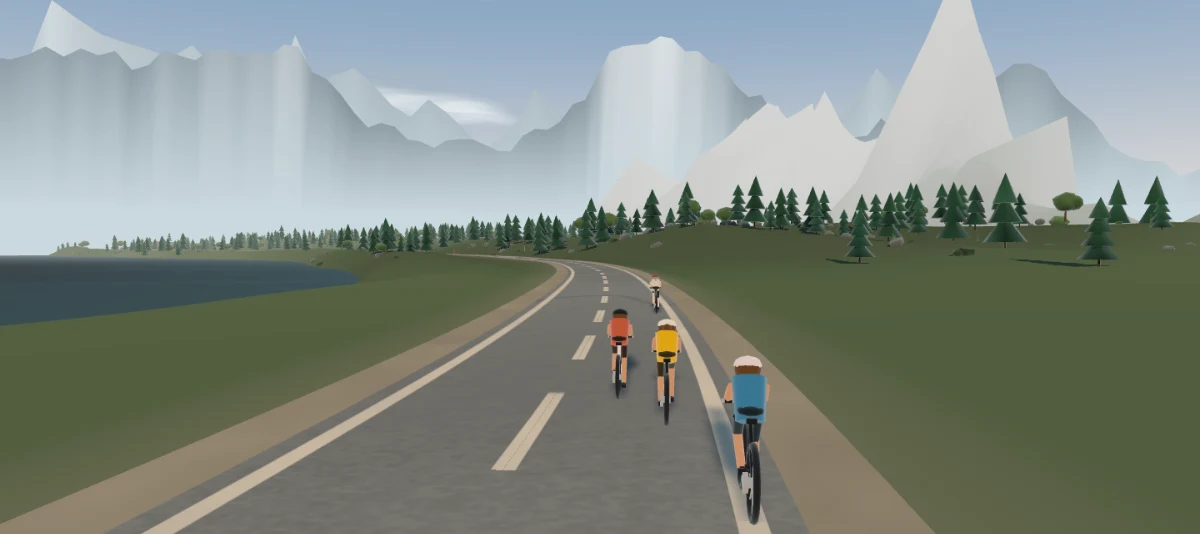
Your own courses. Drop in a GPX file and you ride that course: its real gradients, and — as of this week — its real bends, with scenery grown from what genuinely stands along the road. Race recon on the actual profile, eight weeks out.
Structured sessions that size themselves. Set your FTP, say how long you have, pick easy spin, endurance, sweet spot, threshold or VO2 max. Warm-up and cool-down scale, the main set repeats as many times as fits, and the total is exact to the second. On a trainer with ERG the target is held for you.
Riding with people. Share a link and a friend drops onto your road beside you. Sitting on a wheel actually shelters you, so a turn on the front costs what it should.
Rides that stay yours. Every ride saves as a .fit file to your own machine — Strava, intervals.icu, TrainingPeaks and Garmin Connect all import it directly. Nothing is uploaded from here. OpenCycle has no training log of its own and is not trying to become one.
One honest caveat about worlds. Zwift rotates guest worlds: Watopia plus two others are on the Drop In screen at any given time, though you can reach the rest by selecting a workout first. OpenCycle's thirty are all there all the time. It is a smaller difference than it first sounds, and it is the kind of thing a comparison post usually overstates.
What Zwift does that OpenCycle does not
A comparison that only runs one way is an advert, so here is the other direction, and none of it is small.
- People, in numbers. Zwift's population is the product. Category-enforced racing, a full events calendar, a pen of forty strangers at 7am on a Tuesday — OpenCycle has none of that. You ride with the friends you invite.
- It runs on almost anything. Apple TV, iPad, iPhone, Android, PC, Mac. OpenCycle needs a Chromium browser (see below), which rules out a lot of living rooms.
- Multi-week training plans with progression and a coach's structure behind them, rather than single sessions.
- Ten years of course design. Zwift's worlds are drawn by people, with landmarks you learn and segments you know the shape of. Generated road is endless and never the same twice, which is the opposite trade: nothing to memorize, nothing to come back to.
- Progression. Levels, drops, unlockable frames. OpenCycle has none of it.
If what keeps you pedaling is a race number and a category, pay the $19.99. That is a real thing to want and OpenCycle does not have it.
What you need to ride it
A Bluetooth trainer or power meter, and Chrome, Edge, Opera or Samsung Internet. Reaching a trainer from a web page needs Web Bluetooth, which is Chromium-only — Firefox and Safari cannot do it, and neither can anything on iOS, because every browser there is WebKit underneath whatever the icon says. No polyfill is possible for a radio API, so the pairing panel says so rather than offering a button that cannot work.
You do not need a smart trainer. A basic wheel-on turbo and a $20 speed sensor work: OpenCycle counts wheel revolutions against the resistance curve of your trainer and shows its working — Wheel 31.2 km/h → 248 W — so you can check it against something you trust. Nothing else in the game treats that ride differently.
Is it actually free, or free-for-now?
Free, and the architecture is the reason rather than the promise. The expensive parts of a virtual cycling platform are artists drawing worlds and servers streaming them; OpenCycle has neither, because the road is computed on your machine from a seed. Riding together moves a few bytes a second — positions are only sent when the other end's guess would have drifted, which on a steady effort is close to never.
The app speaks English, Deutsch, Français, Español, Italiano and Nederlands, including the numbers: a comma decimal is a comma decimal, which matters more than it sounds when you are typing an FTP on a French keyboard.
Try it against your own turbo
There is nothing to install and no trial to start counting down. Open the app, pair a trainer, and ride until you know whether it is for you. If it is not, you have lost an evening rather than $199.99.